ORA – Telecoms Service Control Platform

Turn complexity into commercial agility

Convert business intent into governed network execution without replacing the existing platforms.

Service control

A unified control layer for any network cloud tech stack

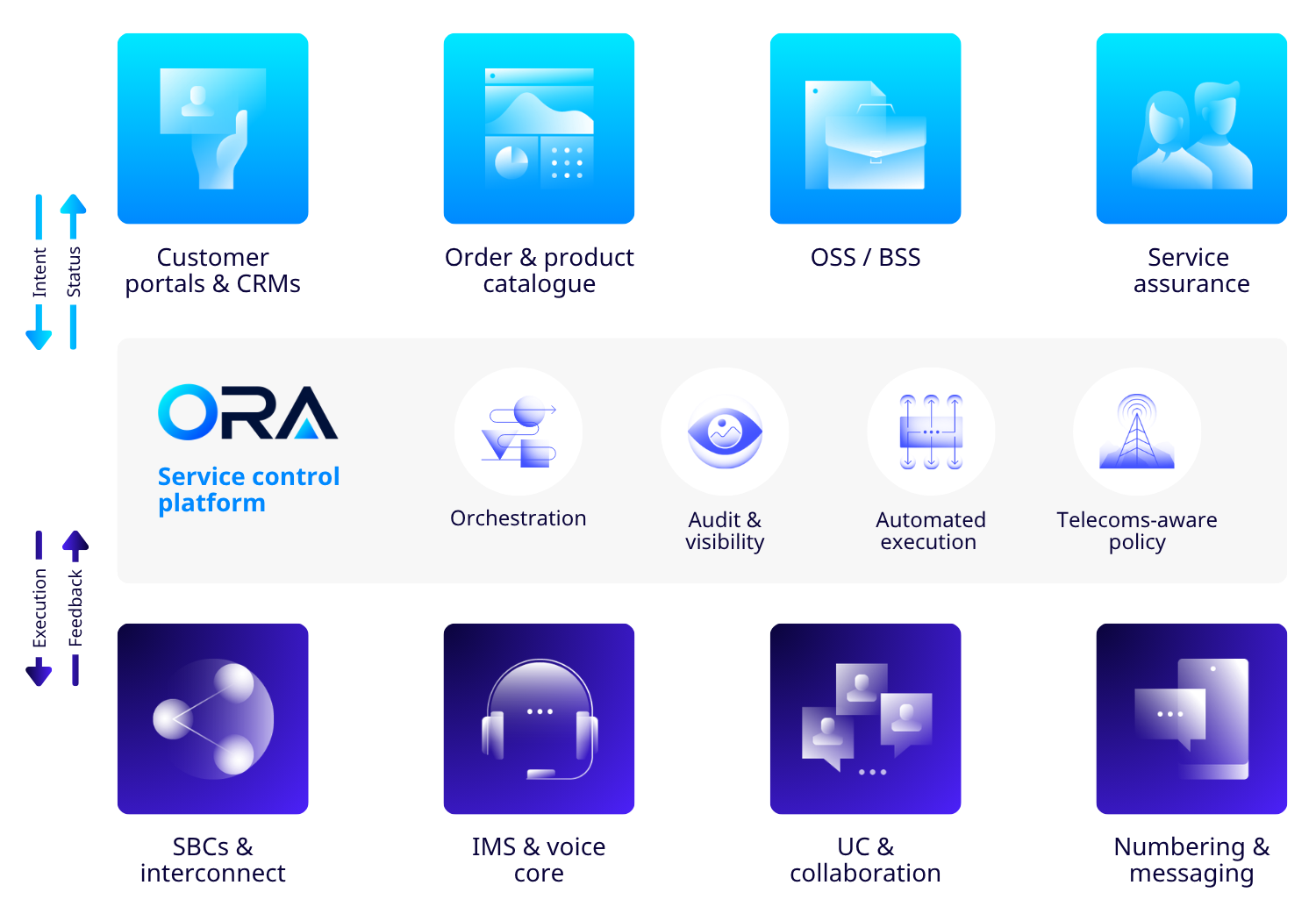
Portals, CRM, order systems and OSS/BSS state what a service needs. ORA validates the request, applies telecom-aware policy, coordinates the work across SBCs, IMS and voice core, UC, number and messaging platforms, then returns status and audit evidence upstream.

icon loop

Faster time to market

Each new service starts from existing service models, workflows and adapters.

icon saving

Protect existing investment

New services build on the OSS/BSS and network platforms you have already paid for.

icon growth

Lower operational friction

Multi-system work runs automatically, and exceptions are visible.

icon vision future-look

Observable execution

Central policy, reason codes, audit records and end-to-end status for every change.

Why ORA?

New services should not wait for the next release train

Most operators connect business systems directly to network platforms. Each new service adds another point-to-point integration. Business systems fill up with network logic, network elements collect duplicated customer rules, and operations teams become the manual link between them.

Changes then compete with OSS/BSS backlogs and enterprise risk controls, while multi-vendor SBCs, IMS and voice cores each expose different interfaces. ORA adds a stable control layer in that gap. Northbound systems work against one contract, and vendor specifics stay in ORA’s adapters

icon process
Orchestrate

Lifecycle automation across platforms

ORA coordinates create, modify, suspend, migrate and verify flows across every system a service touches, and holds the lifecycle state in one place.
Route

Telecoms-aware routing in real time

ORA evaluates call, network, time and risk context against central rules, so routing, trust and resilience decisions are made in one place.
icon networking
icon performance efficiency
Accelerate

Each new service builds on the last

ORA keeps service models, adapters and workflows for reuse, so the next service starts from proven assets. Every action returns status and audit evidence, so teams can change services quickly and safely.
How ORA works

A closed control loop for every service

1. Capture

An order, event or verification request arrives through standard APIs.

2. Validate

ORA checks permissions, relationships, entitlements and formats.

3. Decide

Context is evaluated against routing, trust and resilience policy.

4. Orchestrate

ORA coordinates the systems involved and maintains lifecycle state.

5. Execute

Adapters translate decisions into platform-specific network actions.

6. Assure

Results are correlated, evidence is recorded and status returns upstream.

use cases

Two different services. One control layer.

The first use case builds the adapters and information models. The second reuses them. The same assets then carry into SIP-trunk automation, number governance, enterprise onboarding and UC migration.

Service resilience: Public-cloud

In public-cloud SDN environments, Layer-2 HA mechanisms such as GARP are often unavailable or insufficient. ORA adds a policy-driven recovery layer around the SBC pair.

icon cloud meeting online

Customer trust: Verified Voice

Spoofed caller IDs and cloned voices make the displayed name an unreliable signal, so customers are left to judge whether a call is genuine. Verified Voice gives them an operator-controlled trust signal instead.

icon support service

Service resilience: Public-cloud

In public-cloud SDN environments, Layer-2 HA mechanisms such as GARP are often unavailable or insufficient. ORA adds a policy-driven recovery layer around the SBC pair.

icon cloud meeting online

Customer trust: Verified Voice

Spoofed caller IDs and cloned voices make the displayed name an unreliable signal, so customers are left to judge whether a call is genuine. Verified Voice gives them an operator-controlled trust signal instead.

icon support service
Want to get started with ORA?

Book a focused discovery workshop. We will pick one service, map the systems it touches and agree what a first deployment should prove.